

By the time I hit my mid-fifties, my bathroom counter looked like a compounding pharmacy. Nine bottles, jars, and tubes, half of them past their date, most of them leftovers from a gift set I never asked for. I read the ingredient labels out loud to myself and still couldn't tell you what half of it was doing on my face, or in what order any of it was supposed to go on. If you're standing in front of your own crowded counter wondering what you can actually cut without your skin falling apart, this is the five-step routine I landed on after all that trial and error. No serum with a seven-syllable name you have to look up, no eleven-step routine borrowed from a twenty-five-year-old on the internet. Just five steps, done in order, morning and night, anchored by one moisturizer, L'Oreal Paris Revitalift Triple Power, that earned its spot after I stopped rotating through everything else.
This isn't a roundup of every product on the market, and it isn't a promise that five steps will undo forty years of sun exposure. It's the routine that actually held up once I stopped buying something new every time an ad caught me in a weak moment. It works whether your skin leans dry, like mine does, or you're dealing with unexpected oiliness for the first time in decades thanks to hormone shifts. What follows is the order I do these five steps in, why each one earns its place, and what I skip most days without a shred of guilt. I've also included what I quietly dropped from my old routine, because half the point of simplifying is admitting a few of those old bottles were never doing much of anything.
Tired of a Bathroom Counter Full of Half-Used Bottles?
Before you buy one more serum, start with the step that carries the most weight for the least effort. L'Oreal Paris Revitalift Triple Power is the moisturizer anchoring this routine, and it's worth checking today's price before you build the rest of the routine around it.
Amazon Check Today's Price on Amazon →Step 1: Cleanse Without Stripping Your Skin
Skin over fifty has a thinner, slower-repairing barrier than it did at thirty, which means the foaming, squeaky-clean cleansers a lot of us grew up on do more harm than good now. I switched from a foaming face wash to a gentle, creamy, non-foaming cleanser about six years ago and my skin has been less reactive ever since. If your face feels tight or tingly right after washing, that's not a sign the cleanser is working. It's a sign it's stripping oil your skin can no longer replace as quickly as it used to.
I wash with lukewarm water, never hot, and I pat my face dry with a clean towel instead of rubbing. It sounds like a small thing, but rubbing a washcloth over crepey skin around the eyes and jaw adds up over years of daily friction. Twice a day is enough. I don't own a cleansing brush anymore, and I don't miss it.
One more thing worth checking on the back of your cleanser bottle: sulfates, usually listed as sodium lauryl sulfate. They're what make a cleanser foam up into that satisfying lather, and they're also what strip the natural oils a fifty-plus face can't spare. I'm not asking anyone to become a label detective over every product they own, but the cleanser is worth the thirty seconds it takes to check, since it touches your face twice a day, every day, for years.
Step 2: Treat While Your Skin Is Still Damp
This is the step most routines skip, and it's the one that changed how well everything else absorbed. Right after cleansing, while my skin is still a little damp, I apply whatever active treatment I'm using that day. In the morning that's a vitamin C serum, which I go into in more detail in how to fade age spots with a vitamin C serum. At night, on the days I use it, that's a retinol, and if you've never used one before, I wrote a slower, gentler starting plan in how to start retinol after 50 because going in too fast is how most people quit after one bad week.
If you're new to actives, don't add both a vitamin C morning routine and a retinol night routine in the same week. Pick one, give your skin two or three weeks to get used to it, then layer in the other. I learned this one the hard way with a week of flaking I didn't need to have.
Patch testing feels like an extra step nobody has time for, but at this age it's cheaper than dealing with a full-face reaction three days before an event. I put a small amount of any new active on the inside of my forearm for two nights before it ever touches my face. It's not glamorous, but neither is explaining a rash to your grandkids over video call.
I keep the order the same every single day: cleanse, treat, moisturize, protect, without exception. Once that order became automatic, the whole routine stopped feeling like a decision I had to make every morning and started feeling like brushing my teeth. That habit-forming part matters more than any single product on this list, because a great serum used twice a week does less for your skin than an average one used every day.
The gradual part matters more than people expect. I didn't start this routine all at once. I added the cleanser change first and lived with it alone for two weeks. Then the moisturizer. Then, a month later, the vitamin C. Retinol came last, almost two months in, because it's the ingredient most likely to cause a reaction and I wanted to know exactly what was causing it if my skin protested. Rolling out five changes on the same Monday morning is how people end up unable to tell which product caused the redness.
Step 3: Moisturize Every Morning and Every Night
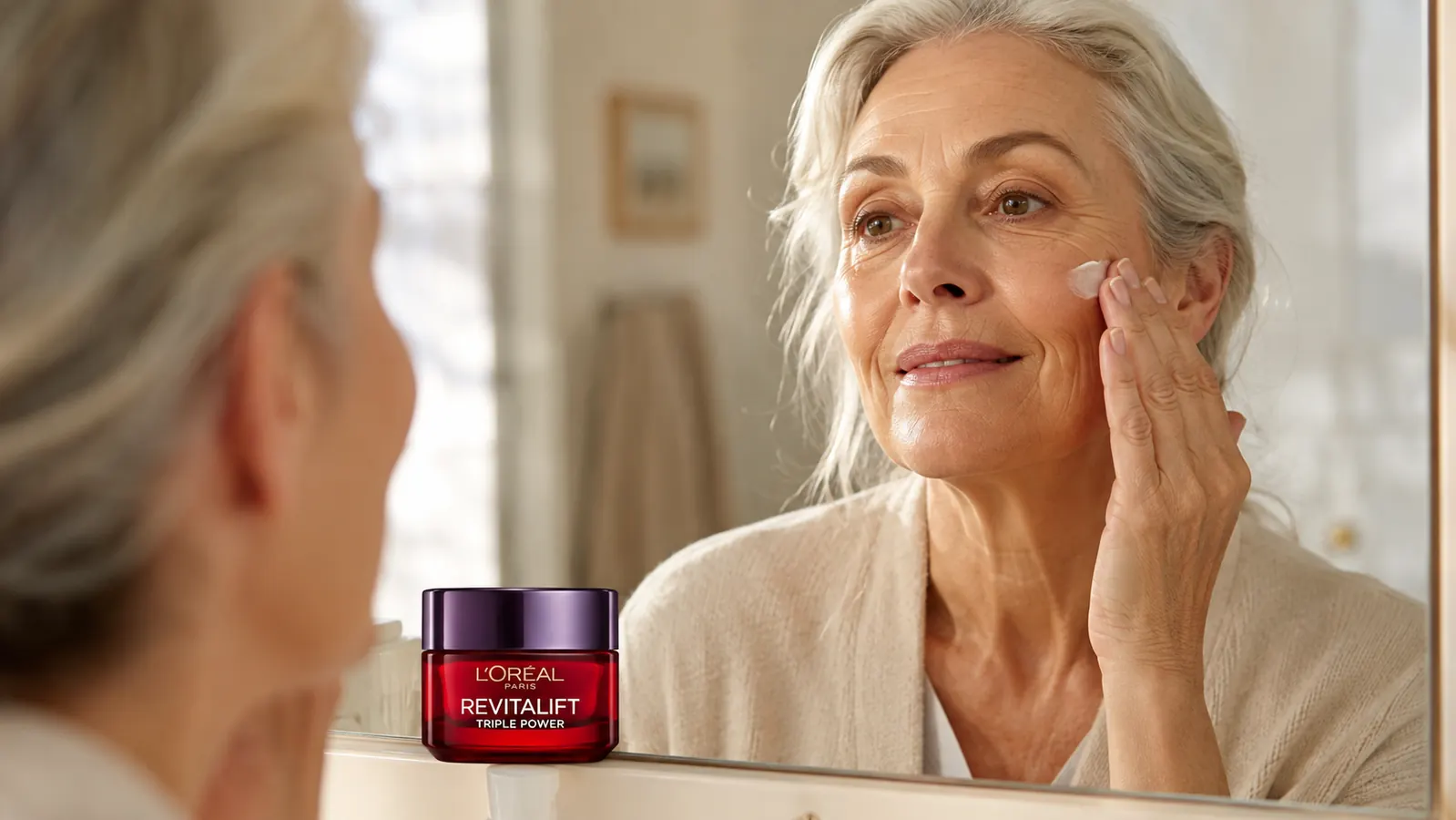
This is the step that does the most work in the whole routine, and it's the one people skip most often because they assume a serum is doing the heavy lifting. It isn't. Skin over fifty produces less of its own natural oil and repairs its moisture barrier more slowly, so a daily moisturizer isn't optional the way it might have felt at thirty. My anchor here is L'Oreal Paris Revitalift Triple Power, which combines a mild pro-retinol, hyaluronic acid, and vitamin C in one jar rather than asking me to layer three separate products every single day.
I use about a dime-sized amount, morning and most nights, patted on rather than rubbed in hard. The texture is a light, whipped gel-cream that sinks in within a minute or two, which matters if you're applying makeup right after or you just don't want to walk around feeling greasy. The one real complaint I have with L'Oreal's packaging is the jar lid, which is stiff enough to be genuinely annoying on a morning when my arthritis is acting up. I keep a butter knife by the sink to help pry it open on the bad days.
If you want the full ninety-day account of how this specific moisturizer performed on dry, mature skin, including what it didn't fix, I wrote that up in my long-term L'Oreal Revitalift review. And if you're still not convinced a daily moisturizer deserves a permanent spot on your counter at all, 10 reasons mature skin needs a daily moisturizer lays out the case better than I can in one paragraph here.

Step 4: Protect With Sunscreen, No Exceptions
Every single morning, rain or shine, sunscreen goes on last, over the moisturizer. This matters more now than it did twenty years ago, partly because sun damage is cumulative and partly because retinol, even a mild pro-retinol like the kind in Revitalift, can make skin a little more reactive to UV. I use a mineral sunscreen because it's gentler on my rosacea-prone cheeks, but the honest truth is that the best sunscreen is the one you'll actually put on every day without fail.
Cloudy days are not a pass. I used to skip sunscreen on overcast mornings until a dermatologist friend pointed out that UV rays don't care whether I can see the sun. It takes fifteen seconds. There's no version of this routine where that step is optional.
If you're out for more than a couple of hours, midday reapplication matters more than the SPF number on the bottle. I keep a small pressed-powder sunscreen in my purse for exactly this, since reapplying a liquid sunscreen over makeup at a restaurant table is not a battle worth fighting. It's a small habit that took me longer to build than any of the other four steps combined.
Step 5: Give the Routine Twelve Weeks Before You Judge It
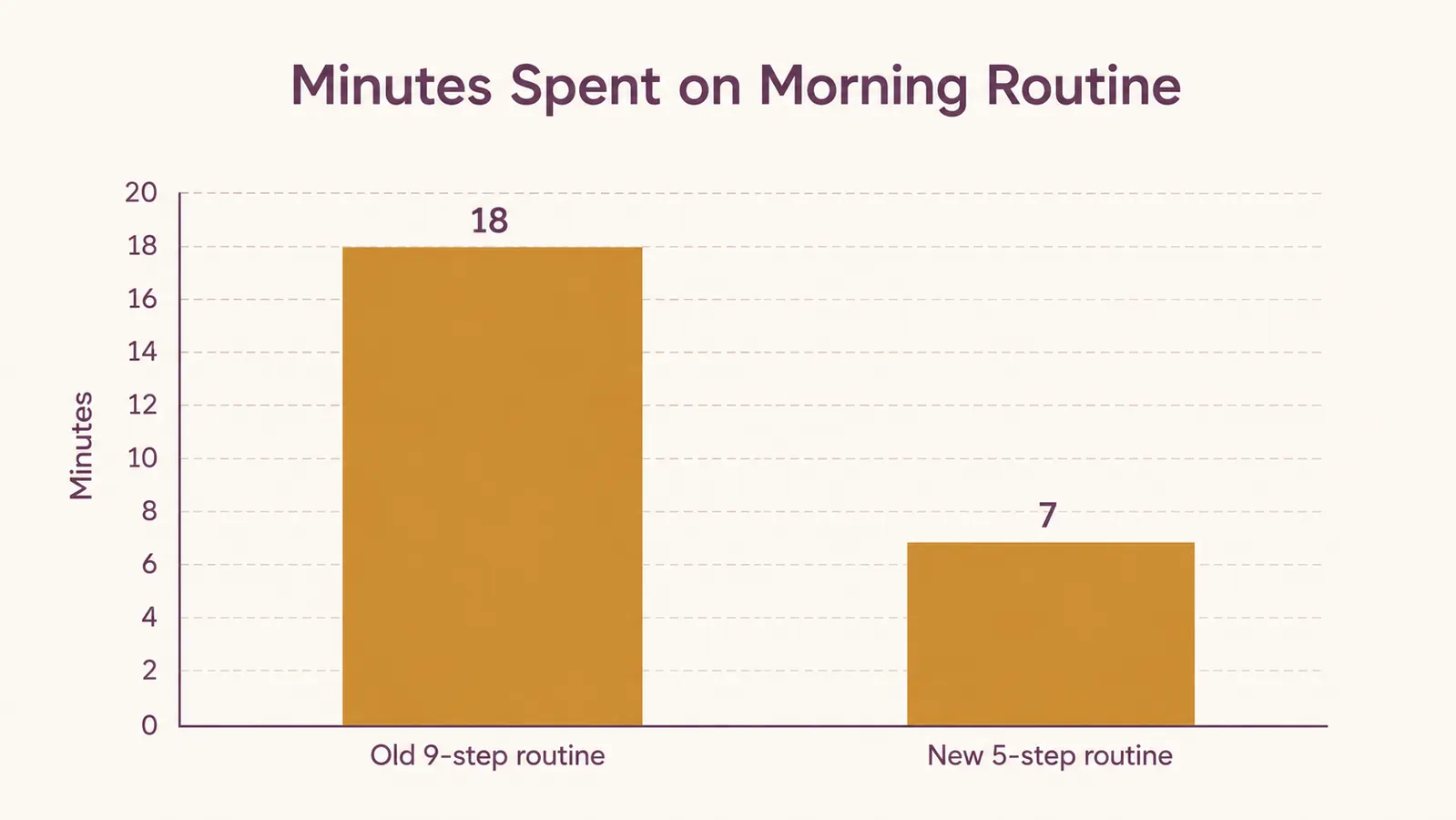
The single biggest mistake I made in my forties was switching products every two or three weeks because I didn't see a miracle fast enough. Skin cell turnover slows down with age, which means visible change takes longer to show up than it used to, not because the product is failing but because your skin is working on its own clock now. I went from a cluttered nine-step routine that used to eat up nearly eighteen minutes of my morning to this five-step version that takes about seven, and the extra time back mattered almost as much as the results.
Pick your five steps, write them down if you have to, and stay with them for a full twelve weeks before you decide anything isn't working. I log a quick note in my phone once a week, nothing fancy, just how my skin felt that day. It's the only way I've found to tell the difference between a real trend and a bad night's sleep.
Written out plainly, my mornings are cleanse, vitamin C serum, L'Oreal Revitalift, sunscreen, four steps in about seven minutes. My evenings are cleanse, retinol on the nights I use it, L'Oreal Revitalift again, three steps, closer to five minutes since I'm not waiting on sunscreen to set before I can leave the house. That's the whole routine, morning and night, written down so there's no mystery about what "five steps" actually means day to day. If your version looks different because your skin is oilier or drier than mine, that's fine. The structure matters more than the exact products filling each slot.
What Else Helps
None of this replaces sleep, water, or a pillowcase you actually wash on a regular schedule, and I'd be lying if I said skincare alone undid decades of sun exposure on my own face. A humidifier in the bedroom during dry winter months made a bigger visible difference to my skin than any single serum I've tried. So did finally admitting that the wine before bed wasn't doing my under-eye puffiness any favors.
Diet gets oversold in most skincare articles, so I'll keep this modest: I eat more protein now than I did at forty, mostly because a dermatologist mentioned collagen production slows with age and protein is a building block for it. It's one small piece next to sleep, sunscreen, and consistency, not a substitute for any of them.
On mornings when I'm genuinely rushed, here's what I cut and what I don't. The treatment serum is the one I'll skip without guilt, since missing a day of vitamin C or retinol here and there doesn't undo weeks of consistent use. Cleansing, moisturizing, and sunscreen are the three I never skip, because those are the steps doing the daily protective work rather than the slower cosmetic improvements. The most common mistake I see people make when they try to simplify their own routine is cutting sunscreen first because it feels the most optional, when it's actually the one step with real consequences for skipping it regularly.
The second common mistake is the opposite problem: deciding to overhaul everything on the same day, tossing out a whole cabinet of products and starting five new ones at once. That's how you end up back at a crowded, confusing counter within a few months, just with different bottles on it. Simplifying works better as subtraction over several weeks than as a single dramatic reset.
Stress shows up on my face faster than it used to, usually as a flush across my cheeks that no amount of concealer fully hides. I can't hand you a fix for that in a skincare article, but I can tell you that the weeks I sleep worse are the same weeks my skin looks worse in the mirror, routine or no routine. If you're doing all five steps faithfully and still not happy with what you see, sleep and stress are worth looking at before you blame the products.
What this five-step routine does is give you a floor to stand on. Cleanse, treat, moisturize with something that's actually earning its spot, like L'Oreal Revitalift has earned its spot on my counter, protect, and stay consistent. Everything else, the collagen supplements, the neck creams, the eye patches, is worth trying once your foundation is solid, not before.
The routine that actually works is the one boring enough that you're still doing it in month six.
Five Steps Is Plenty. Start With the One That Does the Most.
If you only add one product from this whole routine, make it the moisturizer holding the other four together. Check today's price on the L'Oreal Paris Revitalift Triple Power moisturizer before you build the rest of the routine around it.
Amazon Check Today's Price on Amazon →